by Sachnev Lezhnev and John Prendergast
Enough experts lead you down the path of the 3Ts—tin, tantalum, tungsten—and gold from the mines of Eastern Congo all the way to your cell phone.


UN Peacekeeping Force Knowingly Supports Abusive Military Operations
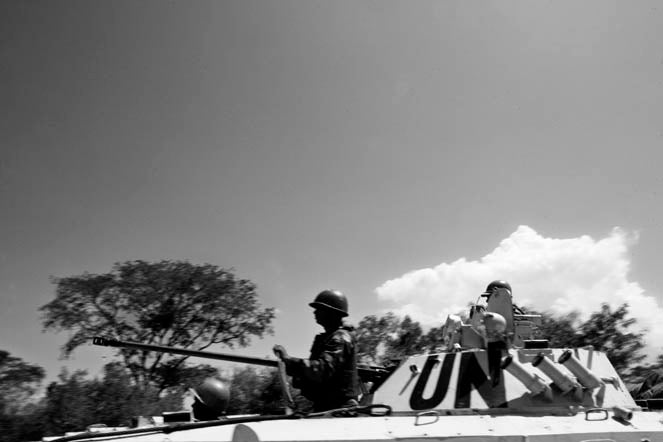
UN forces in North Kivu, Democratic Republic of Congo.
© 2008 Marcus Bleasdale/VIISome Congolese army soldiers are committing war crimes by viciously targeting the very people they should be protecting. MONUC's continued willingness to provide support for such abusive military operations implicates them in violations of the laws of war.
(New York) - Congolese armed forces in eastern Democratic Republic of Congo have brutally killed hundreds of civilians and committed widespread rape in the past three months in a military operation backed by the United Nations, Human Rights Watch said today.
Human Rights Watch called on the UN peacekeeping force in Congo, MONUC, to immediately suspend its support to the military operation or risk being implicated in further atrocities.
In two fact-finding missions in eastern Congo in October 2009, Human Rights Watch documented the deliberate killing by Congolese soldiers of at least 270 civilians between the towns of Nyabiondo and Pinga in a remote part of North Kivu province since March. Many of them had been killed during two massacres in August at Mashango and Ndoruma villages. Most of the victims were women, children, and the elderly. Some were decapitated. Others were chopped to death by machete, beaten to death with clubs, or shot as they tried to flee.
"Some Congolese army soldiers are committing war crimes by viciously targeting the very people they should be protecting," said Anneke Van Woudenberg, senior researcher at Human Rights Watch. "MONUC's continued willingness to provide support for such abusive military operations implicates them in violations of the laws of war."
The UN peacekeeping mission, MONUC is a partner with the Congolese army in operation Kimia II, which began on March 2. The aim is to disarm by force the Democratic Forces for the Liberation of Rwanda (FDLR), a Rwandan Hutu militia group, some of whose leaders participated in the genocide in Rwanda in 1994. MONUC provides substantial operational and logistics support to the soldiers, including military firepower, transport, rations, and fuel.
One of the massacres occurred in early August at Mashango hill, 15 kilometers from Nyabiondo, where UN peacekeepers have a base. According to witnesses interviewed by Human Rights Watch, at least 81 civilians were killed when Congolese army soldiers attacked five hamlets within a few kilometers of one another, only one of which contained rebel combatants. The attacking Congolese soldiers made no distinction between combatants and civilians, shooting many at close range or chopping their victims to death with machetes.
In one of the hamlets, Katanda, Congolese army soldiers decapitated four young men, cut off their arms, and then threw their heads and limbs 20 meters away from their bodies. The soldiers then raped 16 women and girls, including a 12-year-old girl, later killing four of them.
On about August 15, Congolese army soldiers massacred another group of civilians in the Nyabiondo area at the village of Ndoruma. Witnesses said that soldiers returning from a failed attack against a local militia allied to the FDLR earlier in the day deliberately killed at least 50 civilians whom they accused of collaborating with the FDLR and their allies. One woman witnessed soldiers kill her husband and then watched in horror as they torched her home, burning to death her three young children inside.
Congolese army soldiers also targeted civilians on the 10-kilometer stretch of road from Nyabiondo to Lwibo. On September 28 and 29, soldiers based at Kinyumba village along the road, abducted and gang-raped two separate groups of young women and girls, about 20 altogether, on their way to the market. When a local militia allied with the FDLR attacked the government soldiers the same day, they were repulsed by the soldiers, who called in help from MONUC's attack helicopters. Some of the women and girls escaped, but Congolese army soldiers killed at least five as they tried to flee.
On October 29, MONUC reported that the Congolese army had begun further military operations in the area north of Nyabiondo, raising concerns about more attacks on civilians.
Human Rights Watch conducted 21 fact-finding missions in North and South Kivu from January to October 2009, and found that Congolese army soldiers had deliberately killed at least 505 civilians from the start of operation Kimia II in March through September. Another 198 civilians were deliberately killed by Congolese army soldiers and their Rwandan army allies during an earlier five-week joint operation, known as Umoja Wetu, in late January and February.
Human Rights Watch also documented brutal retaliatory attacks by the FDLR militia, which has deliberately targeted Congolese civilians in response to government military operations. Between late January and September, the militia group deliberately killed at least 630 civilians, many in the areas of Ziralo, Ufumandu and Waloaluanda, on the border between North and South Kivu provinces.
"War crimes committed by the FDLR militia are absolutely no justification for Congolese government soldiers to commit atrocities," Van Woudenberg said. "The UN should be asking hard questions about the role of its peacekeepers in supporting such abusive operations."
UN officials have repeatedly told Human Rights Watch that they joined operation Kimia II because they believed their participation could help minimize harm to civilians. MONUC's mandate from the UN Security Council, Resolution 1856, permits it to support Congolese army operations against the FDLR and other armed groups. Since operations began, MONUC has made some notable efforts to protect civilians, which have undoubtedly helped to save lives.
The peacekeeping mission's mandate, however, requires it to attach "the highest priority" to protecting civilians. According to a January 13, 2009 note from the UN Office of Legal Affairs, and two subsequent legal notes from the same office on April 1 and October 12, shown to Human Rights Watch, MONUC has an obligation, in advance of agreeing to support any military operations with the Congolese army, to ensure that such operations are planned and conducted in accordance with international humanitarian law. MONUC may not participate in any operations in which there are substantial grounds to believe that the Congolese army units involved might violate international humanitarian law.
The same legal notes also say that MONUC has an obligation to cease its participation in operation Kimia II if it has credible information that the Congolese army is committing gross human rights violations and if attempts to intercede to stop the violations fail.
In May, Human Rights Watch published detailed information on war crimes committed by Congolese army soldiers involved in operation Kimia II. The UN's own investigations in 2009 also revealed that Congolese government soldiers were regularly committing crimes. During mid-2009, MONUC staff drew up a confidential list of 15 Congolese army officers with a track record of serious human rights abuses who were believed to be involved in operation Kimia II, which was presented to the mission's leadership.
UN peacekeeping officials told Human Rights Watch in May, June, and July that concerns about human rights violations committed by Congolese army soldiers involved in operation Kimia II were being discussed privately with Congolese government authorities. In September, the peacekeeping mission belatedly developed a draft policy setting out conditions for its support to operation Kimia II based on respect for human rights, which it submitted to the Congolese government for comment. On October 30, MONUC and the Congolese army established a joint provincial committee in North Kivu to investigate human rights violations committed by army soldiers and to remove abusive commanders. A similar committee is also to be established in South Kivu.
On November 1, Alain Le Roy, the head of the UN Department of Peacekeeping Operations announced during a visit to Congo that MONUC would suspend its support to the Congolese army's 213th Brigade operating in the Nyabiondo area. According to Le Roy, MONUC's own investigations had revealed that Congolese army soldiers had killed at least 62 civilians in the Lukweti area, just north of Nyabiondo. It is not yet clear how the suspension will be put into effect.
"Peacekeeping officials knew that war crimes were being committed by Congolese government forces, yet eight months into operation Kimia II, they are only now suspending the UN's support to one of the army units responsible," Van Woudenberg said. "Nyabiondo is not the only area where Congolese army soldiers are committing abuses. MONUC should immediately cease its support to all of operation Kimia II until abusive commanders are removed and effective measures are in place to protect the civilian population."
The Congolese government has also not removed well-known abusers of human rights from the army's ranks. Bosco Ntaganda, wanted on an arrest warrant for war crimes from the International Criminal Court, remains a general in the Congolese army and plays an important role in operation Kimia II, causing further problems for MONUC's support of the operation.
Military operations since January, including operation Kimia II, have resulted in the disarmament of 1,243 FDLR combatants from an estimated strength of 6,000, but the FDLR continues to recruit and its ability to attack civilians remains intact. MONUC should develop a comprehensive strategy to disarm the FDLR, making protection of civilians a priority. Its mandate permits peacekeepers to use force to disarm the FDLR on its own, without joining forces with the abusive Congolese army. The April 1 legal note from the Office of Legal Affairs specifically sets out this option.
"MONUC's continued participation in operation Kimia II, against its mandate and the UN's own legal advice, implicates UN peacekeepers in abuses," Van Woudenberg said. "Urgent consideration should be given to other options to disarm the FDLR militia that won't entail further Congolese army abuses against the people of eastern Congo."


